
What is Domestic Abuse?
Domestic Abuse can be categorised as abuse that anyone who is 16 years and above experience as a result of marital conflict that could be seen in incidents that exhibit characteristics of control, coersion, threatening, violent behaviour with the intention to degrade including aspects of sexual violence in the majority of the cases that are reported both by partners, ex-partners, family members or carers.
It was estimated that by the end of March 2019, 2.4 million adults experienced Domestic violence with no significant change in the numbers reported last year.
Domestic abuse is often considered to be a hidden crime and often doesn't get reported or even if reported is only partially reported which prevents this crime from entering the Criminal Justice System.
Domestic violence is a complex issue because it does exist across various cultures and classes, the forms it takes and the responses to it varies as per the cultural background of the offender and the perpetrator leading it to be considered a complex problem, often making its impact difficult to assess.
For women who have experienced domestic violence from multiple family members and have gone through stigma from their community for disclosing the abuse, being able to speak to a support worker in their own language can be a 'lifeline'.
Cycle of Domestic Abuse
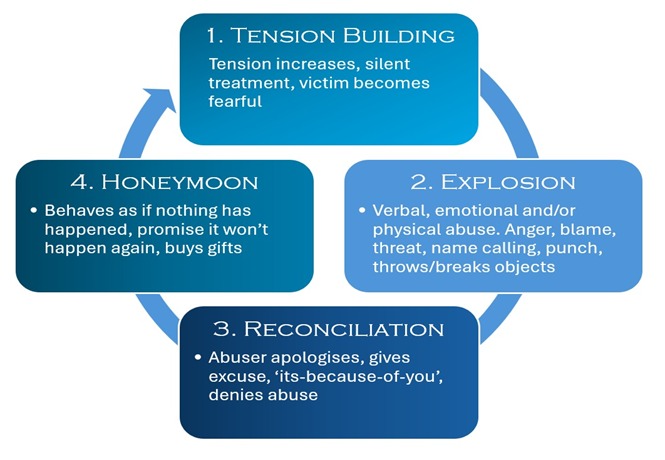
This image shows the Cycle of Domestic Abuse, a repeating pattern of behaviour that often occurs in abusive relationships. It's divided into four main stages:
- Tension Building – Stress and conflict start to rise. The abuser may use silent treatment or become moody, while the victim feels anxious, walks on eggshells, and tries to avoid making things worse.
- Explosion – The abuse happens. This can include verbal, emotional, or physical violence, such as shouting, name-calling, threats, hitting, or breaking things.
- Reconciliation – The abuser may apologize, make excuses, or deny what happened, often blaming the victim or external factors ("It's your fault," or "I was stressed").
- Honeymoon – The abuser behaves kindly, acts as if nothing happened, may buy gifts, promise change, and show affection to regain control and prevent the victim from leaving.
Reference
Crime Survey for England and Wales, 2019.
Anita, S. (2010). No Resources, No Support: State Policy and Practice towards South Asian Women Facing Domestic Violence in the UK, British Journal of Social Work, 40, p. 462-479.